How to Choose a Tracked Dumper for Orchards, Slopes and Muddy Ground
Compare payload, route width, slope, tracks, tipping bed, braking and transport requirements when selecting a compact tracked dumper for orchard and farm work.
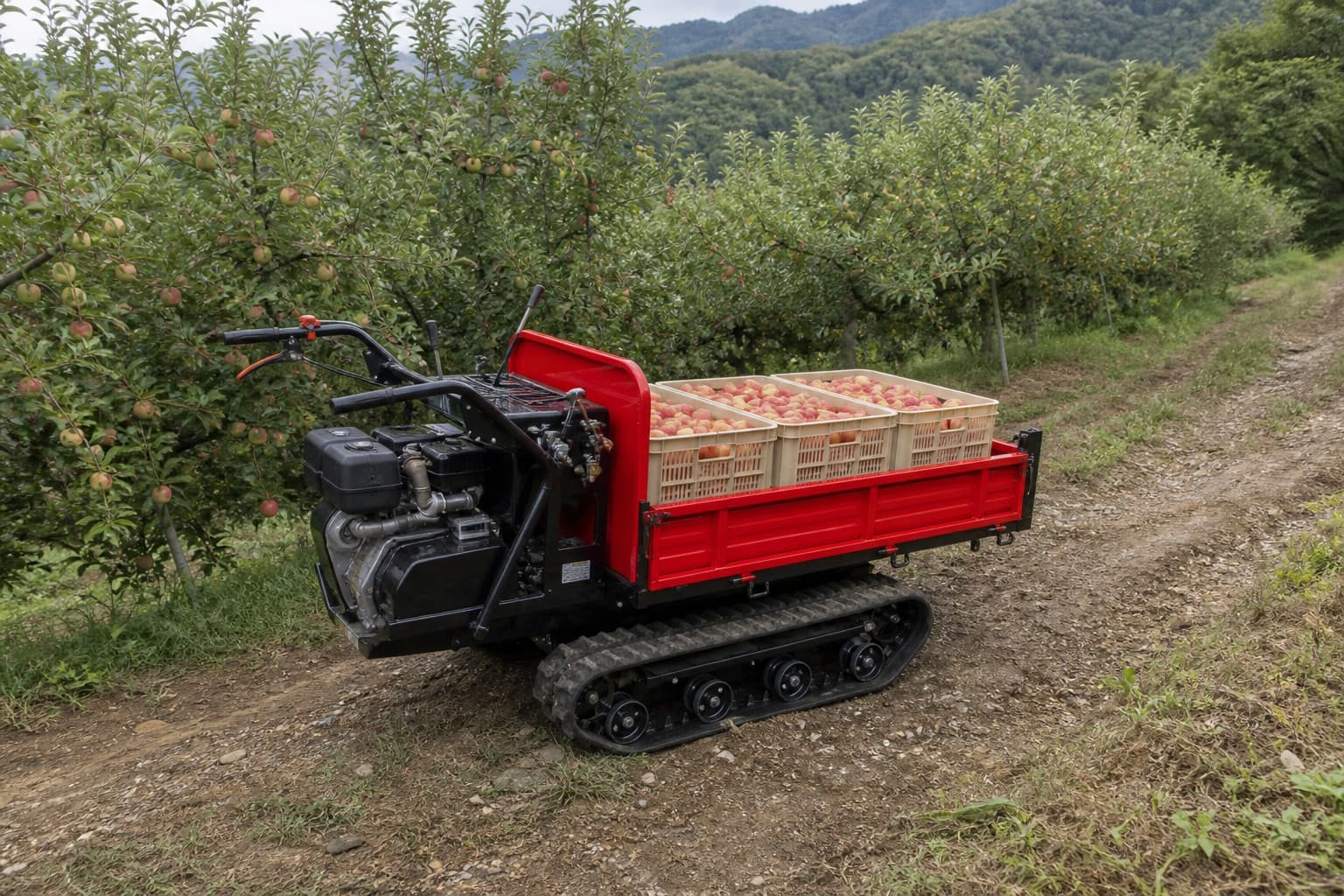
Start with the load and route
Choose a tracked dumper around the material, route, and unloading task rather than the largest payload shown on a specification sheet. Fruit, fertilizer, soil, feed, tools, logs, and construction materials place different demands on the cargo bed, weight distribution, traction, and tipping system.
Record the heaviest normal load, typical travel distance, number of trips per day, loading method, and where the material must be discharged. A machine that is suitable for short orchard runs may need a different configuration for repeated hillside transport or confined construction work.
Measure route width and access
Measure the narrowest gate, orchard row, bridge, ramp, and storage entrance. Also check overhead branches, turning space, loading ramps, and the clearance required for safe operation. Select a machine with a practical margin instead of one that only just fits the measured opening.
The TT800 listing, for example, gives an overall width of 800 mm and a 1.2 m turning radius. These figures should be reconfirmed for the exact machine and configuration before an order is placed.
- Narrowest usable route width and height
- Tightest turning point and row-end space
- Bridge, ramp, trailer, and floor load limits
- Mud depth, ruts, roots, stones, and side clearances
Compare level-ground and slope payload correctly
Payload is not automatically the same on level ground and on a slope. Gradient, surface grip, load height, weight distribution, braking, travel direction, and operator practice all affect safe capacity. Ask for separate guidance for level and inclined routes.
Published TT800 data lists an 800 kg rated load on level ground and 600 kg on slopes. Treat these as configuration-specific reference figures that must be checked against the actual route and the supplier's current operating instructions—not as universal safe limits.
Match the tracks to mud, slopes, and uneven terrain
Crawler tracks spread the machine load over a longer contact area and are commonly considered for soft, muddy, rutted, or uneven routes. Track width and pattern, ground clearance, machine weight, and steering method all influence traction and surface disturbance.
Ask how the quoted track specification performs on the actual surface and how track tension and wear are maintained. Photos or a short route video are useful when the site combines mud, side slopes, loose stone, roots, or drainage channels.
Choose the unloading method and cargo bed
A hydraulic tipping bed can reduce manual unloading, but the tipping direction, hinge position, bed dimensions, side height, and discharge clearance must match the material and work area. Confirm whether the bed is intended for loose material, crates, tools, logs, or another load type.
Before ordering, verify that the machine can remain stable at the intended unloading point and that there is enough overhead and rear clearance to tip safely. Do not plan to tip on a slope unless the operating instructions explicitly permit the specific condition.
Review engine, transmission, braking, and operating safety
Compare engine type, starting method, transmission, travel speed, steering controls, service access, and braking arrangement as one working system. A headline climbing angle is not a substitute for operating guidance.
The published TT800 listing states a maximum climbing angle of up to 45 degrees. This should not be interpreted as a safe continuous working slope in every direction, surface, weather, or load condition. Request the current manual and confirm operating limits for the real route before use.
- Braking and parking procedure on gradients
- Maximum permitted longitudinal and side slope
- Load placement and securing requirements
- Emergency stopping and loss-of-traction procedure
- Operator training, inspection, and exclusion zones
Plan transport, spare parts, and destination compliance
Confirm operating weight, shipping dimensions, packaging, lifting points, trailer or container method, and local unloading equipment. Check whether fuel, battery, or other shipping restrictions affect delivery.
Ask for manuals, filters, belts, track parts, seals, service items, warranty terms, and parts lead times. Import, engine, safety, and workplace requirements vary by destination, so provide the final country and intended use before the configuration is confirmed.
Prepare a useful quotation request
A detailed inquiry helps the supplier recommend a workable configuration and quote the correct packaging and freight. Include route photos or video where possible, especially if the machine will work on slopes or soft ground.
- Cargo type, target payload, and loading method
- Narrowest route width and tightest turning area
- Typical and actual maximum slope
- Surface condition in wet and dry weather
- Travel distance, trips per day, and unloading method
- Quantity, destination, shipping term, and required documents
Frequently asked questions
Is a tracked dumper better than a wheeled dumper?
Tracked dumpers are commonly considered for soft, muddy, rutted, or uneven routes, while wheeled machines may suit firmer and more open ground. The better choice depends on the route, load, turning space, transport needs, and maintenance plan.
How much can a tracked dumper carry on a slope?
There is no universal slope payload. Safe capacity depends on gradient, surface grip, travel direction, load position, braking, weather, and the exact machine configuration. Ask for model-specific slope guidance and provide route photos or video.
Is the published maximum climbing angle a safe continuous working slope?
No. A published maximum climbing figure is a reference under particular conditions, not permission for continuous loaded operation on every surface or in every direction. Follow the current operating manual and confirm the real application with the supplier.
Can a compact tracked dumper fit orchard rows?
It may, but measure the narrowest row, gate, turning area, branches, ramps, and storage entrance. Allow an operating margin and confirm the exact overall dimensions of the quoted configuration.
What information is needed for an accurate quote?
Provide cargo type, target payload, route width, maximum slope, surface condition, travel distance, unloading method, quantity, destination, and any required compliance documents. Photos or a short route video improve model matching.